Don't Restart the Week Every Wednesday: Protect Your Commitments When Priorities Change

Most founders don't struggle to set priorities on Monday. They struggle to keep the week intact by Wednesday.
A new client request appears. A delivery issue escalates. A cash timing concern surfaces. A partner introduces an opportunity that "can't wait." The result is familiar: the week gets restarted, commitments become diluted, and execution turns reactive again.
This is not a planning failure.
It is a reliability problem.
The Founder Operating System introduced throughout this Field Notes series exists for one purpose: reliable execution. Operating Rhythm, Business Readiness, documentation practices, the Weekly Evidence Review, Decision Log, RACI, and the Weekly Capacity Gate all work together to help founders execute consistently as complexity increases.
Reliability protects credibility over time. It also prevents founders from living in a constant state of re-triage, where every new request quietly replaces yesterday's commitments without an intentional decision.
This Field Note introduces an executive operating principle that protects reliability when reality changes: the Replacement Rule.
The Weekly Capacity Gate establishes the commitments that define the week.
The Replacement Rule protects those commitments when reality changes.
The Founder Problem: “The Week Keeps Getting Rewritten”
When priorities shift midweek, founders often absorb the change informally:
“Just add this too.”
“We’ll squeeze it in.”
“We’ll figure it out later.”
“Everyone do what you can.”
That language sounds flexible.
In practice, it creates hidden tradeoffs:
something else gets delayed without being named
ownership becomes unclear
decisions remain open
evidence becomes harder to interpret because commitments were never stable
The outcome is predictable:
Activity increases, but reliability decreases.
The Principle: Reliability Requires Protected Commitments
Reliability is not rigidity.
It is the ability to execute consistently under changing conditions.
A reliable business can:
absorb change without losing control
keep commitments clear even when priorities shift
maintain ownership and decision clarity
produce evidence that reflects reality
This is why credibility is maintained—not assembled.
Reliability is the visible result of disciplined operating practices.
The Replacement Rule (Founder-Scale)
Replacement Rule: Every meaningful new commitment must either replace an existing commitment or become an explicit future commitment.
This is not a slogan.
It is a discipline that prevents the week from being rewritten without tradeoffs.
If you accept a new priority without replacement, you are not being flexible.
You are silently reducing reliability.
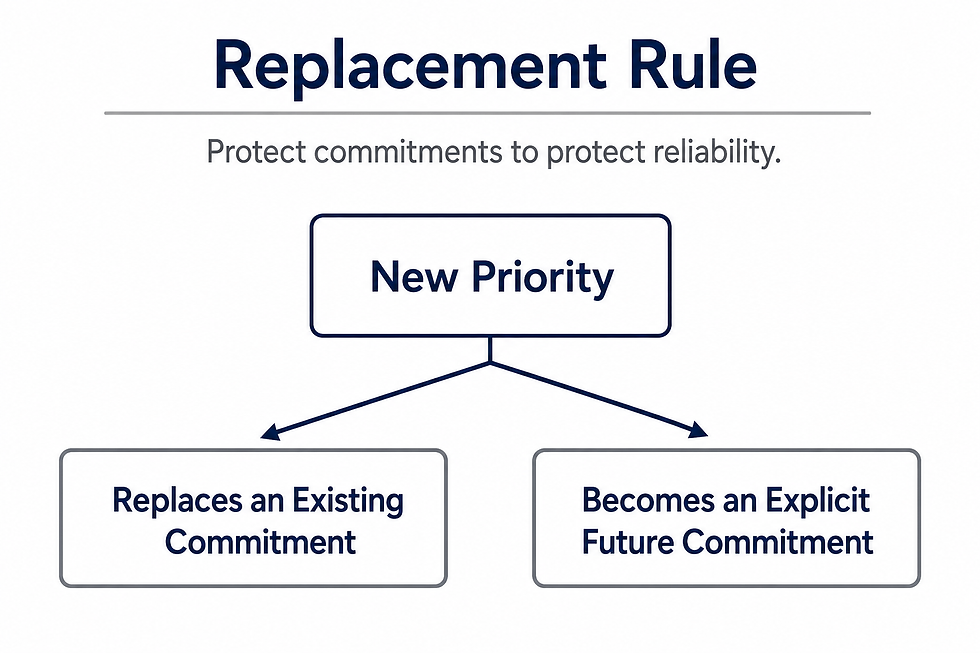
The Decision Questions to Ask When a New Priority Appears

Instead of a procedural checklist, use these executive questions. They are designed to reconnect directly to the Founder Operating System.
1) Is this truly a higher priority?
Not every urgent request is a priority.
Ask:
Does this protect delivery reliability, cash timing, or a critical relationship?
Is the cost of delay higher than the cost of replacement?
Is this a decision, or just noise?
If it is not truly a higher priority, it becomes a future commitment—or it is declined.
2) What will it replace?
This is the core reliability question.
If the new commitment is real, name what is being displaced:
Which of the top three outcomes is being replaced?
Which deferred item is now being pulled forward?
What is explicitly moving to “not this week”?
If you cannot name the replacement, you are not making a decision.
You are accepting drift.
3) What decision is being made?
Every meaningful change is a decision—not simply a new task.
Before moving forward, define exactly what is changing. Is the decision altering priorities, scope, timing, resources, or your current level of risk? Clarity at this stage prevents the week from quietly drifting away from its original commitments.
Reconnect to the Decision Log:
Record the decision in one clear sentence.
Identify the decision owner.
Specify when the change takes effect (this week or a future week).
Update the decision status (Open, Decided, or Implemented).
A documented decision creates organizational clarity.
An undocumented decision becomes an assumption—and assumptions have a way of resurfacing later as operational drift.
4) Who now owns the change?
Replacement without ownership creates confusion.
Reconnect to RACI:
Who is Accountable for the outcome now?
Who is Responsible for execution?
Who must be Consulted before the change is implemented?
Who must be Informed after the change?
Ownership is how reliability survives change.
5) How will success be measured?
A new commitment without evidence expectations becomes an open loop.
Reconnect to the Weekly Evidence Review:
What evidence will demonstrate completion?
What does “done” mean by the end of the week?
What signal will be reviewed next week?
If success cannot be measured, the commitment is not ready to be accepted.

How This Protects the Weekly Capacity Gate
Field Note #8 introduced the Weekly Capacity Gate to prevent unbounded demand from defining the week.
The Replacement Rule protects that gate when reality changes.
The Weekly Capacity Gate establishes the week's commitments.
The Replacement Rule governs changes to those commitments.
Together, they prevent one of the most common founder failure modes:
Restarting the week repeatedly without making explicit tradeoffs.
Common Failure Modes (and Corrections)
"Just add it" becomes the default.
Correction: Apply the Replacement Rule. Every meaningful new commitment either replaces an existing commitment or becomes an explicit future commitment.
Replacement is implied, not explicit.
Correction: Document what is being replaced alongside your weekly outcomes.
Ownership is unclear after the change.
Correction: Confirm Accountable ownership (RACI) before execution begins.
Success is vague.
Correction: Define the evidence that will demonstrate completion and review it during the next Weekly Evidence Review.
Decisions aren't documented.
Correction: If a change affects priority, scope, timing, resources, or risk, record it in the Decision Log.
Next Step: Determine the Appropriate Pathway
Reliable execution is not a personality trait.
It is the result of disciplined operating practices that continue to perform under pressure.
Growing businesses are not defined by how often priorities change.
They are defined by how consistently they protect the commitments that matter most—especially when priorities change.
If you are unsure whether your immediate priority is operational discipline, readiness development, capital preparation, or a more structured growth pathway, begin with Gateway Access to determine the most appropriate next step.


