Reliable Execution Is Built, Not Assumed: The Founder Operating System


Most founders are not short on effort. They are short on reliability.
The business is busy. The calendar is full. The team is moving. Yet outcomes still close inconsistently. Delivery slips. Decisions linger. Priorities multiply. The week gets rewritten. Credibility becomes something you try to assemble under pressure rather than maintain through discipline.
This is the operating system the Field Notes series has been quietly building from the beginning.
Operating rhythm, business readiness, documentation discipline, Weekly Evidence Review, decision logs, RACI, the Weekly Capacity Gate, and the Replacement Rule were never intended to stand alone. Together they form a practical management framework designed for founder-scale businesses:
The Founder Operating System exists to produce one outcome: reliable execution.
The Founder Problem: “We’re Busy, But Reliability Is Still Inconsistent”
Inconsistent reliability shows up in predictable ways:
commitments don’t close consistently
decisions remain open and reappear weekly
ownership blurs across handoffs
priorities expand beyond capacity
changes bypass the system and rewrite the week
Founders often interpret this as a leadership or motivation problem. It is usually an operating system problem.
Reliability is built—not assumed.
Why Reliable Execution Is the Advantage
Reliable execution is not a soft concept. It is the operating advantage that supports everything founders care about:
Credibility: Credibility is maintained—not assembled. Reliable execution is the evidence.
Delivery: Consistent closure builds trust with clients and partners.
Decision quality: Evidence improves decisions; decisions improve outcomes.
Cash timing: Reliability reduces surprises and improves predictability.
Customer trust: Trust is earned through consistent delivery, not intent.
Sustainable growth: Growth amplifies the system you already have. Reliability determines whether growth strengthens or destabilizes the business.
Readiness is produced through disciplined execution. Discipline is not a personality trait. It is a system.
Reveal the Founder Operating System
Every operating system exists to produce predictable outcomes. The Founder Operating System exists to produce reliable execution through a small set of reinforcing disciplines.
At a high level, the architecture is simple:
Operating rhythm produces evidence.
Evidence produces decisions.
Decisions require ownership.
Ownership must respect capacity.
Capacity protects commitments.
Protected commitments produce reliable execution.
Reliable execution is sustained through review.
Business Readiness describes the quality of the evidence the system produces, while documentation preserves that evidence so it remains current, traceable, and reviewable.
This is why the system is intentionally small. It is designed to reduce complexity, not create it.
This note is the architecture. Individual Field Notes remain the implementation guides.
How It Operates Weekly (Intentionally Simple)
The architecture explains how the system works. The weekly cadence explains how founders keep it alive.
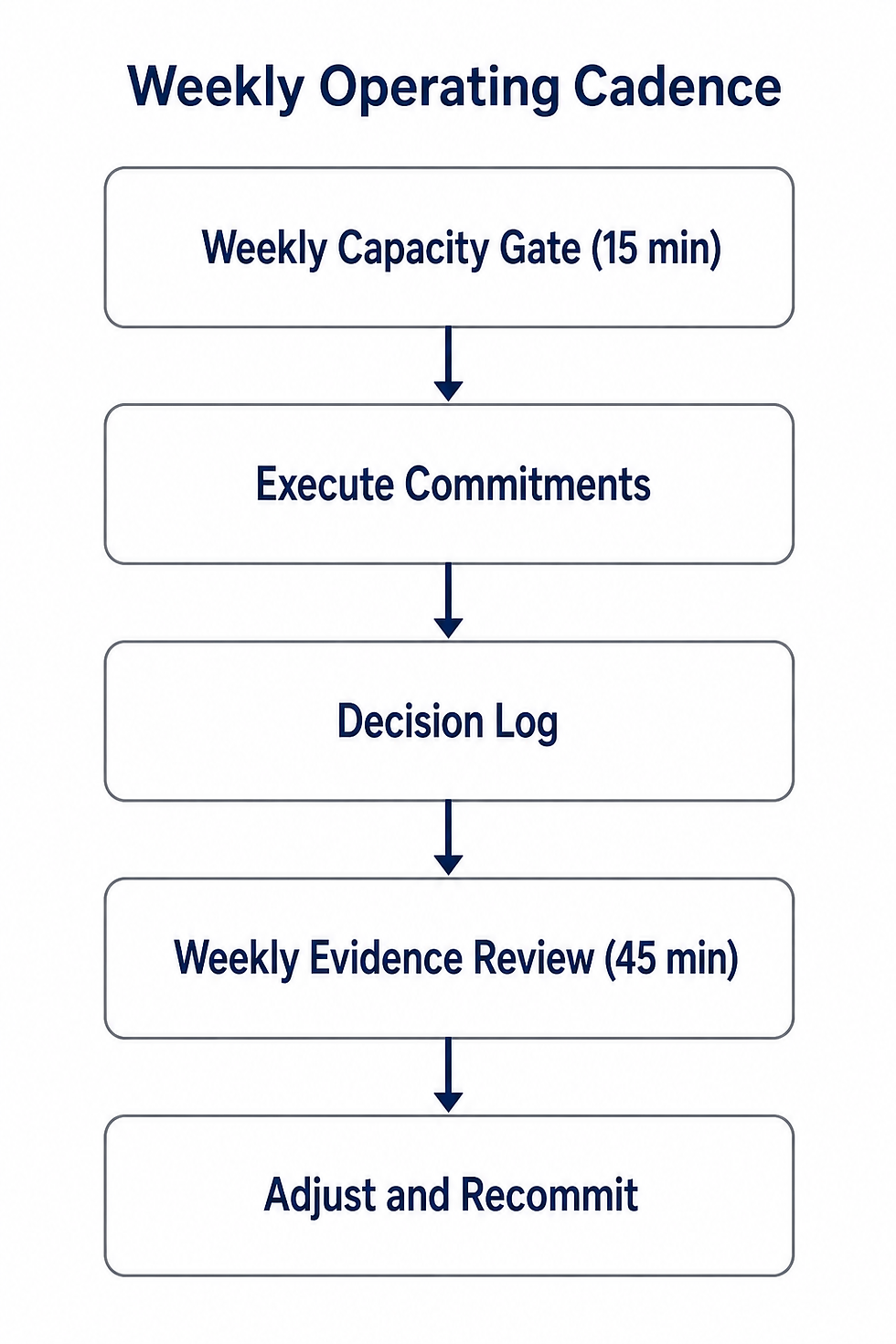
The Founder Operating System is sustained by two recurring practices and two operating artifacts.
Two recurring practices
1) Weekly Capacity Gate (15 minutes)
This protects the week before it is defined by unbounded demand. It forces explicit tradeoffs so commitments remain realistic.
2) Weekly Evidence Review (45 minutes)
This prevents drift by converting evidence into decisions and corrective action—before inconsistency becomes the default.
Two operating artifacts
Decision Log
The Decision Log records decisions, preserves rationale, assigns ownership, and prevents unresolved issues from reappearing without context.
Founder-Scale RACI
This clarifies ownership across the workflows that repeat every week so decisions translate into execution rather than confusion.
Together, these elements create a founder-scale management system that holds under pressure without becoming bureaucracy.
How Systems Break (Four Failure Modes)
Most breakdowns reduce to four failure modes:
Commitments exceed capacity
When capacity is implicit, priorities multiply and reliability collapses.
Decisions remain open
Decision latency becomes the constraint. Execution slows even when effort increases.
Ownership is unclear
Ambiguity creates handoff drift. Work happens, but outcomes don’t close.
Changes bypass the system
When new priorities rewrite the week without replacement, reliability erodes. The system must protect commitments, not restart weekly.
The Founder Operating System exists to prevent these failures by design.
Gateway Access
Reliable execution is not created by working harder. It is created by building a management system that continues to perform as complexity increases. That is the purpose of the Founder Operating System.
Gateway Access is a structured evaluation and the entry point into this operating methodology. Through a focused advisory session, readiness assessment, and pathway recommendation, founders can identify their current operating strengths, constraints, and the parts of the Founder Operating System that require attention first.
Credibility is maintained—not assembled. Reliable execution is built—not assumed.


