Reliable Execution Leaves Evidence: The Operating Indicators That Matter Most

Most founders can tell you their revenue, their cash balance, and whether the month “felt good.”
Far fewer can tell you whether the business is becoming more reliable.
That gap matters because most founders rely on lagging indicators to judge progress:
revenue
profit
cash balance
customer complaints
missed deadlines
By the time these change, operating problems have usually existed for weeks. Reliability rarely fails all at once. It degrades quietly—through open decisions, diluted commitments, unclear ownership, and corrective actions that never close.
Field Note #10 established the Founder Operating System as the architecture that produces reliable execution. The next phase is learning how to manage it. That begins with a simple principle:
Disciplined founders measure the health of the operating system—not only the outcomes it produces.
The Founder Problem: “We’re Busy, But I Don’t Know If We’re Improving”
Busy is not the same as improving.
A founder can be fully booked and still be drifting:
commitments are made, but closure is inconsistent
decisions are discussed, but remain open
ownership exists on paper, but execution stalls in handoffs
the week is planned, then rewritten midstream
corrective actions are identified, then forgotten
Financial results eventually reflect these issues. But they reflect them late.
Reliable execution leaves evidence early.
The Principle: Measure the Operating System Before You Measure the Outcomes
Financial measures matter. They are non-negotiable.
But financial measures are lagging indicators. They tell you what happened after the operating system has already performed—well or poorly.
Operating indicators provide earlier visibility. They reveal whether the Founder Operating System is functioning as intended:
Are commitments protected?
Are decisions closing?
Is ownership clear?
Is capacity respected?
Are corrective actions actually improving execution?
These indicators do not replace judgment. They improve judgment by making operating reality visible before financial results reveal the consequences.
The Five Founder Operating Indicators
This is not a universal scorecard. It is a founder-scale starting point. Choose indicators that reflect your constraints and your stage.
1) Weekly commitments completed (closure rate)
If commitments do not close, reliability is not improving—regardless of effort.
A simple measure:
commitments set vs. commitments closed (weekly)
2) Open decisions remaining (decision latency)
Open decisions are hidden drag. They slow execution and force rework.
A simple measure:
number of decisions still “Open” past their due date
3) Corrective actions closed (improvement rate)
A system that identifies variance but does not close corrective actions is not learning.
A simple measure:
corrective actions created vs. corrective actions closed (weekly)
4) Capacity load (overload signal)
When capacity is consistently overloaded, reliability collapses and the week gets rewritten.
A simple measure:
planned commitments relative to available capacity (high-level)
frequency of midweek replacements (how often the week is rewritten)
5) On-time client deliverables (external reliability)
Internal discipline must show up externally. This is the credibility signal clients experience.
A simple measure:
deliverables due vs. deliverables delivered on time (weekly)
These indicators are intentionally simple. Their value is not precision. Their value is visibility.

How Indicators Connect to the Founder Operating System
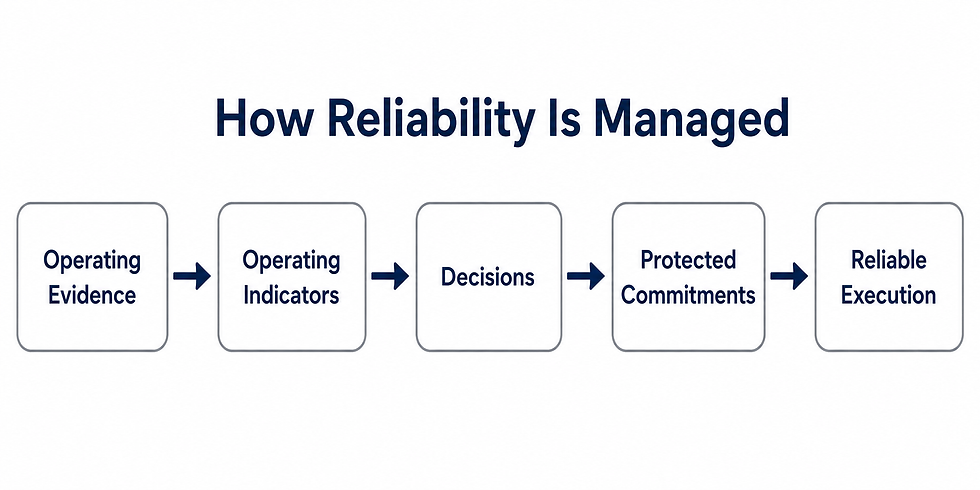
The Founder Operating System is not managed by dashboards. It is managed by review and decisions.
A practical connection looks like this:
Operating Rhythm
↓
Evidence
↓
Operating Indicators
↓
Decisions
↓
Protected Commitments
↓
Reliable Execution
Indicators translate evidence into a clearer operating picture. That picture improves decision quality. Better decisions protect commitments. Protected commitments produce reliable execution.
Common Failure Modes (and Corrections)
Measuring too many things
Correction: start with five. Add only when a constraint demands it.
Measuring only financial outcomes
Correction: keep financial measures, but add operating indicators that predict reliability earlier.
Collecting data without reviewing it
Correction: if it isn’t reviewed in the Weekly Evidence Review, it isn’t an indicator—it’s noise.
Confusing activity with progress
Correction: measure closure, decision latency, and corrective action completion—not busyness.
Gateway Access
Operating indicators should reflect your current stage and constraints. Gateway Access helps founders determine which indicators matter most now, how to interpret them, and which parts of the Founder Operating System require attention first.
Reliable execution is built—not assumed. It is managed—before results force the lesson.